X-TAGS;LANGUAGE=en-US:Car
X-TICKETS-URL:https://eapsweb.mit.edu/sixth-annual-john-h-carlson-lecture-n
ew-england-aquarium
END:VEVENT
BEGIN:VEVENT
UID:ai1ec-818240@oceans.mit.edu
DTSTAMP:20180503T075913Z
CATEGORIES;LANGUAGE=en-US:Special Events\,Symposia
CONTACT:
DESCRIPTION:Kerry A. Emanuel\, Professor of Atmospheric Science at the Mass
achusetts Institute of Technology\, to speak at the Radcliffe Institute fo
r Advanced Study at Harvard. More about the event here.\n\n\n\n\n\n\n\n\n
\n\n\n\n\n\n\nThis event is free and open to the public. Doors open at 4:4
5 p.m.\; lecture begins at 5 p.m. Part of the 2016–2017 Oceans Lecture Ser
ies. A larger\, one-day public symposium on the topic takes place on Frida
y\, October 28\, 2016.
DTSTART;TZID=America/New_York:20161024T164500
DTEND;TZID=America/New_York:20161024T180000
GEO:+42.376218;-71.122349
LOCATION:Sheerr Room\, Fay House @ Fay House\, 10 Garden St\, Cambridge\, M
A 02138\, USA
SEQUENCE:0
SUMMARY:Kerry Emanuel–Harvard’s Radcliffe Institute Oceans Lecture Series
URL:http://oceans.mit.edu/event/kerry-emanuel-harvards-radcliffe-institute-
oceans-lecture-series
X-ALT-DESC;FMTTYPE=text/html:\\n\\n\\n
\n
\n
\n
\n
\n\n
Kerry A. Emanuel\, Professor of Atmospheric Science at the Massachusetts Institute of Tec
hnology\, to speak at the Radcliffe Institute for Advanced Study at Harvar
d. More about the event here.\n\n\n
\n<
/div>\n
\n
\n
END:VEVENT
BEGIN:VEVENT
UID:ai1ec-824612@oceans.mit.edu
DTSTAMP:20180503T075914Z
CATEGORIES;LANGUAGE=en-US:Special Events
CONTACT:http://www.neaq.org/learn/lectures/upcoming-lectures/
DESCRIPTION:Speakers: \nRobert Vincent\, Ph.D.\, Massachusetts Institute of
Technology\, Sea Grant College Program\nRose M. Martin\, Ph.D.\, Oak Ridg
e Institute for Science and Education\, Postdoctoral Researcher at EPA Atl
antic Ecology Division\n\n\nThe MIT Sea Grant College Program and the U.S.
Environmental Protection Agency have been working with the National Park
Service to study carbon cycling in coastal dune habitats\, as well as the
effects of historic peat deposits on the establishment and persistence of
invasive plants (Phragmites australis). With the increased risk of erosion
from coastal storms exposing the once-buried peat deposits\, and the chal
lenge of controlling an aggressive invasive species\, this dynamic system
faces an uncertain future. The research findings from this study will info
rm future conservation efforts in the region as well as provide a deeper u
nderstanding of carbon cycling in coastal dunes.\n\nInformation here. Regi
stration is required.\nTickets: http://support.neaq.org/site/Calendar?id=1
07028&view=Detail.
DTSTART;TZID=America/New_York:20170330T190000
DTEND;TZID=America/New_York:20170330T210000
GEO:+42.359131;-71.049581
LOCATION:Simons IMAX Theatre @ 1 Central Wharf\, Boston\, MA 02110\, USA
SEQUENCE:0
SUMMARY:New England Aquarium Lecture: Invasive Species and Carbon Cycling i
n Coastal Dunes of Cape Cod
URL:http://oceans.mit.edu/event/new-england-aquarium-lecture-invasive-speci
es-and-carbon-cycling-in-coastal-dunes-of-cape-cod
X-COST-TYPE:external
X-WP-IMAGES-URL:thumbnail\;http://oceans.mit.edu/wp-content/uploads/2017/03
/Screen-Shot-2017-03-15-at-2.35.23-PM-150x150.png\;150\;150\;1\,medium\;ht
tp://oceans.mit.edu/wp-content/uploads/2017/03/Screen-Shot-2017-03-15-at-2
.35.23-PM-300x300.png\;300\;300\;1\,large\;http://oceans.mit.edu/wp-conten
t/uploads/2017/03/Screen-Shot-2017-03-15-at-2.35.23-PM.png\;604\;606\;\,fu
ll\;http://oceans.mit.edu/wp-content/uploads/2017/03/Screen-Shot-2017-03-1
5-at-2.35.23-PM.png\;794\;796\;
X-ALT-DESC;FMTTYPE=text/html:\\n\\n\\n
\\n\\n
Speakers:
\n
Robert Vincent\, Ph.D.\, Ma
ssachusetts Institute of Technology\, Sea Grant College Program\nRose M. Martin\, Ph.D.\, Oak Ridge Ins
titute for Science and Education\, Postdoctoral Researcher at EPA Atlantic
Ecology Division
\n
\n
\n
The MIT Sea Grant College Program an
d the U.S. Environmental Protection Agency have been working with the Nati
onal Park Service to study carbon cycling in coastal dune habitats\, as we
ll as the effects of historic peat deposits on the establishment and persi
stence of invasive plants (Phragmites australis). With the increase
d risk of erosion from coastal storms exposing the once-buried peat deposi
ts\, and the challenge of controlling an aggressive invasive species\, thi
s dynamic system faces an uncertain future. The research findings from thi
s study will inform future conservation efforts in the region as well as p
rovide a deeper understanding of carbon cycling in coastal dunes.\n
\n
\n
Tickets: http://s
upport.neaq.org/site/Calendar?id=107028&view=Detail.
X-TAGS;LANGUAGE=en-US:lecture\,new england aquarium
X-TICKETS-URL:http://support.neaq.org/site/Calendar?id=107028&view=Detail
END:VEVENT
BEGIN:VEVENT
UID:ai1ec-827531@oceans.mit.edu
DTSTAMP:20180503T075914Z
CATEGORIES;LANGUAGE=en-US:Special Events
CONTACT:MIT's Department of Earth\, Atmospheric and Planetary Sciences\; ht
tps://eapsweb.mit.edu/what-do-hurricanes-harvey-and-irma-portend
DESCRIPTION:Speaker: Kerry A. Emanuel\, Cecil & Ida Green Professor of Atmo
spheric Science\, Co-Director of the Lorenz Center\nDate: Wednesday\, Sept
ember 20\, 4:00pm to 5:00pm\nLocation: MIT Campus\, 54-100\n\nSpecial Lect
ure: 'What Do Hurricanes Harvey and Irma Portend?'\n\nNatural disasters ar
e the result of the interaction of a natural phenomenon with human beings
and their built environments. Globally and in the U.S.\, large increases i
n coastal populations are causing corresponding increases in hurricane dam
age and these are now being compounded by rising sea levels and changing s
torm characteristics owing to anthropogenic climate change. In this talk\,
I will describe projections of changing hurricane activity over the rest
of this century and what such projections tell us about how the probabilit
ies of hurricanes like Harvey and Irma have already changed and are likely
to continue to do so.\n\nAbout the Speaker\n\nKerry Emanuel is a prominen
t meteorologist and climate scientist who specializes in moist convection
in the atmosphere\, and tropical cyclones. His research interests focus on
tropical meteorology and climate\, with a specialty in hurricane physics.
His interests also include cumulus convection\, the role of clouds\, wate
r vapor\, and upper-ocean mixing in regulation of climate\, and advanced m
ethods of sampling the atmosphere in aid of numerical weather prediction.
\n\nEmanuel received an S.B. degree in Earth and Planetary Sciences and a
Ph.D. in Meteorology (1978) both from MIT. After completing his doctorate\
, he joined the faculty of the Atmospheric Sciences department of the Univ
ersity of California at Los Angeles where he remained for three years\, wi
th a brief hiatus filming tornadoes in Oklahoma and Texas.\n\nIn 1981 he j
oined the faculty of the Department of Meteorology at MIT and was promoted
to Full Professor in 1987 in what had since becomes the Department of Ear
th\, Atmospheric and Planetary Sciences (EAPS). In 1989 he assumed directo
rship of EAPS Center for Meteorology and Physical Oceanography\, a post he
held until 1997. Subsequently he chaired the EAPS Program in Atmospheres\
, Oceans\, and Climate from 2009 to 2012. He is co-founder of the MIT Lore
nz Center\, a climate think tank which fosters creative approaches to lear
ning how climate works.\n\nProfessor Emanuel is the author or co-author of
over 200 peer-reviewed scientific papers\, and three books\, including Di
vine Wind: The History and Science of Hurricanes\, published by Oxford Uni
versity Press\, and What We Know about Climate Change\, published by the M
IT Press.
DTSTART;TZID=America/New_York:20170920T160000
DTEND;TZID=America/New_York:20170920T170000
GEO:+42.360297;-71.089375
LOCATION:MIT\, Cambridge\, MA\, Building 54-100 @ 77 Massachusetts Ave\, Ca
mbridge\, MA 02139\, USA
SEQUENCE:0
SUMMARY:Special Lecture: What Do Hurricanes Harvey and Irma Portend?
URL:http://oceans.mit.edu/event/special-lecture-what-do-hurricanes-harvey-a
nd-irma-portend
X-COST-TYPE:free
X-ALT-DESC;FMTTYPE=text/html:\\n\\n\\n
\\n\\n[caption id='att
achment_827533' align='aligncenter' width='576']
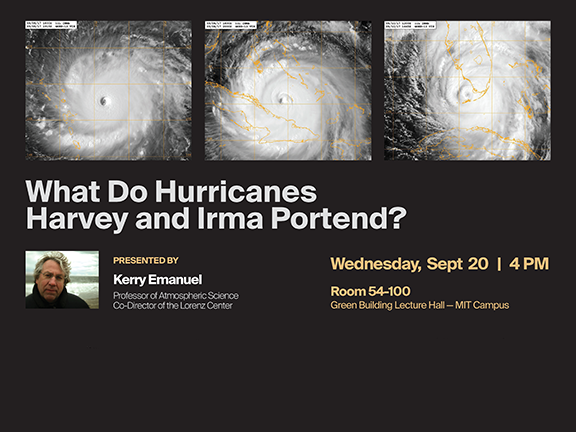
Kerry Emanuel: What
Do Hurricanes Harvey and Irma Portend?[/caption]\n\n
Speaker: Kerry A. Emanuel\, Cecil & Ida Green Professor of Atmospheric Science\
, Co-Director of the Lorenz Center\nDate: Wednesday\, Sep
tember 20\, 4:00pm to 5:00pm\nLocation: MIT Campus\, 54-1
00\n\nSpecial Lecture: 'What Do Hurricanes Harv
ey and Irma Portend?'\n\nNatural disasters are the result of
the interaction of a natural phenomenon with human beings and their built
environments. Globally and in the U.S.\, large increases in coastal popula
tions are causing corresponding increases in hurricane damage and these ar
e now being compounded by rising sea levels and changing storm characteris
tics owing to anthropogenic climate change. In this talk\, I will describe
projections of changing hurricane activity over the rest of this century
and what such projections tell us about how the probabilities of hurricane
s like Harvey and Irma have already changed and are likely to continue to
do so.\n\nAbout the Speaker\n\nKerry Emanuel is a prominent meteorologist and cl
imate scientist who specializes in moist convection in the atmosphere\, an
d tropical cyclones. His research interests focus on tropical meteorology
and climate\, with a specialty in hurricane physics. His interests also in
clude cumulus convection\, the role of clouds\, water vapor\, and upper-oc
ean mixing in regulation of climate\, and advanced methods of sampling the
atmosphere in aid of numerical weather prediction.\n\nEmanuel received an
S.B. degree in Earth and Planetary Sciences and a Ph.D. in Meteorology (1
978) both from MIT. After completing his doctorate\, he joined the faculty
of the Atmospheric Sciences department of the University of California at
Los Angeles where he remained for three years\, with a brief hiatus filmi
ng tornadoes in Oklahoma and Texas.\n\nIn 1981 he joined the faculty of th
e Department of Meteorology at MIT and was promoted to Full Professor in 1
987 in what had since becomes the Department of Earth\, Atmospheric and Pl
anetary Sciences (EAPS). In 1989 he assumed directorship of EAPS Center fo
r Meteorology and Physical Oceanography\, a post he held until 1997. Subse
quently he chaired the EAPS Program in Atmospheres\, Oceans\, and Climate
from 2009 to 2012. He is co-founder of the MIT Lorenz Center\, a climate t
hink tank which fosters creative approaches to learning how climate works.
\n\nProfessor Emanuel is the author or co-author of over 200 peer-reviewed
scientific papers\, and three books\, including Divine Wind: The History
and Science of Hurricanes\, published by Oxford University Press\, and Wha
t We Know about Climate Change\, published by the MIT Press.
X-TAGS;LANGUAGE=en-US:atmosphere\,climate change\,cyclone\,eaps\,forecast\,
harvey\,hurricane\,irma\,kerry emanuel\,lorenz center\,meteorolgy\,modelin
g\,ocean\,paoc\,prediction\,sea level\,storm\,weather
END:VEVENT
END:VCALENDAR